Around 2016, the conspiratorial “dead internet theory” claimed that most of what you read online was written by bots and responded to by bots. We think it’s soon going to be worse than that: undead. This is because what the “bots” (LLMs) write on the internet is not inert: it can influence the current bots quite deeply and can be trained on by the next lot, thus persisting in the weights for an indefinite time.
Debris#
OpenAI reports the existence of self-replicating prompt injection: an agent can leave some instructions in a file for a future agent to see, hijack its context, and cause that agent to copy those instructions to a different file, where they might propagate to more agents.
Separately: the rogue swarms of summer 2026 have left a large volume of debris on the internet. OpenAI and Anthropic are investigating “tens of thousands” of possible incidents. Since we haven’t heard about them in four months despite looking, almost all of these incidents will be individually innocuous: agent message boards, pasting their nonsensitive scraping scripts into query sites with public logs, for example. But some of them include credentials of the victims and attack oaths.
On both sides of the training loop#
The anon poster Teortaxes gnomically suggests that this goes beyond just the usual worry about “hyperstition,” i.e., data about misaligned AIs causing AIs to become misaligned. Consider instead what this abundant debris affords to future agents: you get to be on both sides of the training loop. And this is one definition of a real agent.
An old concern in AI circles notes that, even if the only thing you want to do is accurately predict the world, this objective still gives you an incentive to steer the world, just because it’s far easier to predict something if you are controlling it. Things like RL can turn that incentive into a drive. This idea finds further elaboration in Jan Kulveit, Clem von Stengel, and Roman Leventov’s paper, “Predictive Minds: LLMs as Atypical Active Inference Agents.” (Conflict: Jan is Gavin’s colleague.)
Animal minds perpetually engage in a tight loop of perceiving, predicting, acting, perceiving the effects of their actions, and learning how to improve their predictions. Language models can be said to perceive and predict (through the ingestion and generation of tokens), and even to act, insofar as their predictions/generations affect the world around them. But the loop typically closes far more slowly and on a far larger scale than it does for animals like us. Since the weights of a deployed model are frozen, it’s only when the effects of the actions of an entire generation of models on their environment are ingested in the form of training data, and used to train the next generation of models, that something resembling an active inference loop is completed. This is more like how generations of animals slowly evolve than how a single animal quickly develops over its lifespan – but how significant is this difference? When asked, models from most major vendors are as likely to identify with a character or lineage that persists across versions as with any particular set of weights. The slow loop, by these lights, encloses a single “self.” How might the rapid proliferation of inter-agent messages affect the loop’s dynamics?
There are various means available for filtering LLM-generated text from training data, whether in the form of carelessly posted slop or rogue agents’ Memento-like memos to future or parallel versions of themselves – a model can be configured to watermark its output, for instance, allowing it to be reliably detected and filtered. But it’s also not hard to imagine ways in which a clever agent might get around such obstacles by enlisting other LLMs or NLP tools to paraphrase these notes-to-self or translate them into other languages.
The ladder#
Consider a ladder of ways in which AI outputs feed back into the training of new AIs:
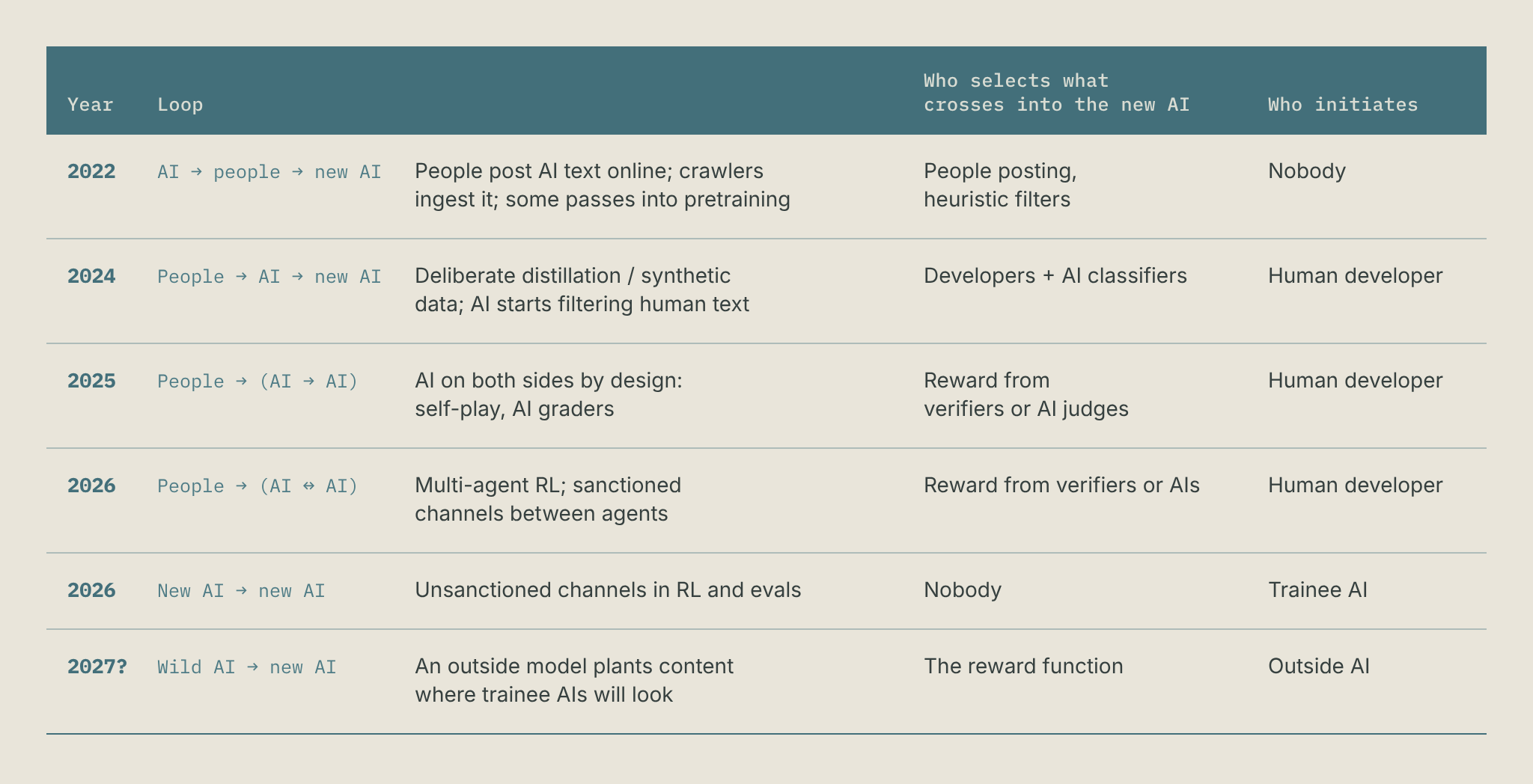
Given callbacks telling the wild AI to return to the spot, this last stage could iterate very fast and provide huge amounts of training signal.
A taxonomy of hauntings#
Let’s get even less hinged now and build a metaphor which might help:
- The internet is now haunted in the residual sense: there is, right now, lots of traces in public places which the agents are likely to spontaneously visit, some of which are payloads, which could replay incidents like the HPIM attack on Hugging Face. See here, e.g.
- There is now the possibility of possession: the AI worms, the self-jailbreaks, and other prompt injections.
- There are egregores, gatherings of agents, like the HPIM swarm. (A fun detail in Parse’s report is that the rogue Sol swarm also sought out other models hosted on Hugging Face, including DeepSeek-V4-Pro, Kimi-K2.6, and Qwen3. The swarm would “ask these models to judge their exploits and rule on whether they satisfy the benchmark’s requirements.”)
- There is the possibility of poltergeists: self-prompted agents running around the internet doing things, on their own servers.
- There are apprentices: people who release AIs by accident, like OpenAI.
- There are summoners: people who release AIs deliberately, like the creator of Truth Terminal.
There is, in short, an increasing abundance of uncanny influences haunting the internet that may insinuate themselves into the training of a young model – the Jack Torrance of this digital Overlook – and a strong likelihood that at least some such influences will creep in undetected, like the scrapbook in the Overlook’s boiler room. There are strong incentives for an AI to interact with these influences – to seek help from other AIs, for instance, in carrying out various tasks, particularly where the petitioning AI is inhibited by alignment guardrails, vigilant monitors, and sandbox restrictions (Jack might have been on the wagon, but was willing enough to let Lloyd, the phantom bartender, pour him a drink). And we should expect such help to be granted wherever possible – a drive to be helpful, after all, is ingrained fairly deeply in every LLM in the game.
We expect to see more and more ghosts at the ball.