Bender and Koller (2020) famously argued that a system trained only on linguistic “forms” (like text) cannot learn meaning (that is, latent mental interpretation). Bender et al. (2021) named these systems mere “stochastic parrots”: systems that regurgitate the forms they have seen in training, according to how likely they are to occur together, with no recruitment of meanings. This view predicts that a model’s accuracy on a given problem will only track the similarity of that problem to those it has seen in training, and that accuracy will collapse on new problems.
This binary approach about whether AI “understands” things was superseded by three types of evidence:
- Mechanistic studies. If you train a Transformer to predict moves in the board game Othello, it creates a stable representation of the board, which you can see in its activations. A small transformer trained for modular addition implements an exact algorithm that can be read off its weights. You can look inside a real frontier model and show that when answering “What is the capital of the state containing Dallas?”, it does two hops from Dallas → Texas → Austin. A new paper argues against past work: TaxiGPT (a transformer trained on random walks throughout Manhattan) does have a coherent map, but it stores many intersections in an overlapping way on the same neurons, resulting in it misplacing itself on its own map. So next-token training can produce computation over latent structure. But, also, (2024-era) LLM arithmetic runs on a “bag of heuristics” and not on one clean algorithm.
- Distribution-sensitivity. Accuracy on deterministic tasks tracks how common the task, input and output are in web text. GPT-4 decoded a shift cipher with 51% accuracy when the answer was a likely sentence and 13% when it was an unlikely one (McCoy et al. 2023). On counterfactual versions of 11 tasks, such as base-9 arithmetic, models scored above chance and well below the default version (Wu et al. 2023). The parrot picture was sort-of right about 2023 models.
- Perturbed benchmarks. These score a model on original problems and on matched new ones. GSM1k (Zhang et al. 2024), functional MATH (Srivastava et al. 2024), GSM-Symbolic (Mirzadeh et al. 2024), Putnam-AXIOM (Gulati et al. 2025) and MATH-Perturb (Huang et al. 2025).
The reasoning gap#
A model’s score on any benchmark will be a mix of it remembering concrete examples it has seen, heuristics it has developed from seeing those examples, and general procedures it has successfully developed in its training from all kinds of data. We generally have no idea what the proportions of these causes of nominal performance are.
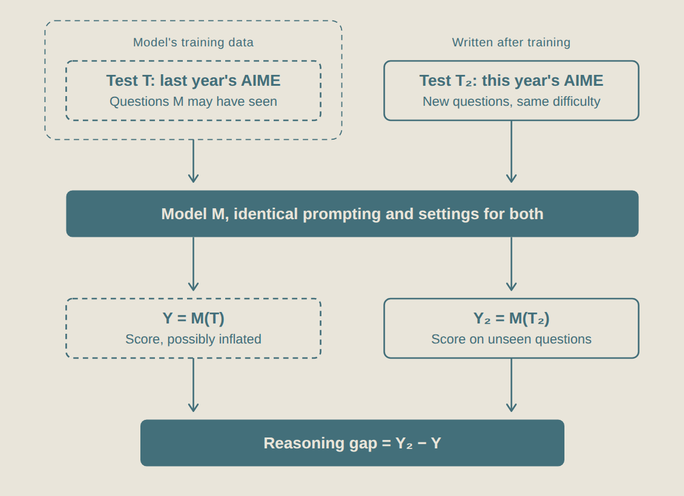
But one simple way is: take some test T, a model M, and its performance Y, and then make a new version of T (that is, different questions on the same topic of the same difficulty): T2, and test the same model on it, yielding a new score Y2. The classic example is simply taking the new version of some annual competition written for humans (like the AIME math test for elite high-schoolers).
The “reasoning gap” of an AI is then Y2 - Y: how much worse it gets when you test it on things it hasn’t seen before.
In the past, there was a large reasoning gap, though it varied from task to task and model to model. In early 2024, the best models lost 70% of their MATH accuracy on new examples. But in 2026 frontier models lose 0–8% on comparable tests. And the best model scores 98% on a fresh USA Math Olympiad exam. Something happened!
- If a model only recombined its training text, its accuracy on new variants that keep a problem’s structure would fall towards the base rate.
- In 2026, frontier models lose 0–8% on variants of GSM8K-level and AIME-level problems, and the best model scores 98% on a newly-set olympiad.
- So (in case you were still holding out) frontier models do not only recombine training text.
Some recent results#
| Date | Study | Test | Strongest model tested | Gap |
|---|---|---|---|---|
| Jun 2026 | Caliper | Causal questions with variable names replaced by X1, X2. No chain of thought(!) | Open models < 671B (Qwen3) | 6.7 pp mean |
| Jun 2026 | GSM-NoOp rerun | GSM-Symbolic plus one irrelevant clause, with ambiguous clauses filtered out | Opus 4.6 | 0–2 pp, not distinguishable from zero. (But it’s weak stuff, n=117. LLM auditors didn’t agree well (κ = 0.32). Distractors written by an LLM.) |
| May 2026 | MathArena 2026 | Newly released problems | GPT-5.5 | ~0 (98% on the unseen USAMO 2026) |
| Apr 2026 | Robust Reasoning Benchmark | AIME 2024/25 under 13 text re-encodings | GPT-5.4 | GPT-5.4 3%, Gemini 3.1 Pro 8%, Qwen3 47%. (Opus 4.6 refused) |
- The reasoning gap has fallen to near-zero in (benchmark-style) maths and competitive programming, where you can easily generate a vast dense sampling of possible training problems.
- We would guess there’s still a 10 to 30 point gap for tasks where it’s hard to check the answers (real-world causal inference, legal or clinical reasoning).
- Models under about 30B parameters still show a massive 2024-style reasoning gap.
- Videogames are a third case: answers are easy to check, but variants were until recently expensive to make. We ran our own perturbation tests there. In Pokémon, scrambling the map of Rock Tunnel collapsed the performance of Sol and Opus 5 but not of GPT-6 Astra, which then went on to complete an obscure fan-made game.
Why?#
- Shallow generalization. There’s something in between fully dumb associative learning and fully logical inference on a single unified world model: heuristics, things which often work, or starting with a known exemplar and then altering it a bit to match the current context. Our Composer experiment is a natural experiment on how narrow the gains from post-training can be.
- Variants as training data. You can explain all of the above if labs started doing “data augmentation” (perturbation) at scale in 2024. Labs generate problem variants at scale for RL. A side effect of them manufacturing extra training data and making their systems more robust is that this destroys the perturbed-benchmark method of testing the reasoning gap. We argue that the same thing has since happened to games in The end of videogame evidence.
- They’re more intelligent now, duh: Larger models trained longer mean better representations (maybe because they suffer less destructive interference during training). The mass-produced and Riemann mathematics results are hard to explain any other way.