Data as of October 30, 2026.
In April we argued that Mythos-class models would not make anything newly possible in cybersecurity, but would make what was difficult easy and what was costly cheap. Half a year on, it is difficult to cover all of the breaking AI hacking stories. We suspect that we may soon be entering an era in which, as with new software, some degree of AI assistance should be taken for granted in any cybersecurity incident, unless there’s reason to believe otherwise. At present, though, the hype seems to be running ahead of the numbers. So what do the numbers say?
Vulnerabilities found#
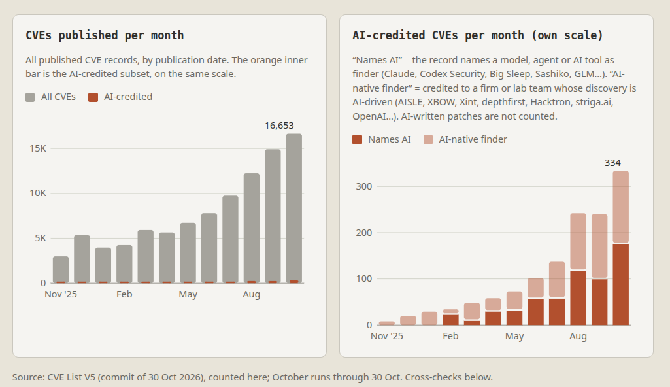
One thing we can say that’s unambiguously true is that the total number of CVEs reported each month has been steadily rising over the past year. Data on how many of these vulnerabilities were discovered with the aid of (or autonomously by) AI is scarce and likely underreported, the rate of increase of the AI-discovered vulns largely the rate of increase of vuln discovery tout court.
Vulnerabilities exploited#
As dramatic as this uptick is, we might wonder if the increase has been more academic than anything else, so let’s look at the rate at which new vulnerabilities are getting exploited in the wild. CISA and VulnCheck track this in their Known Exploited Vulnerabilities (KEV) databases:
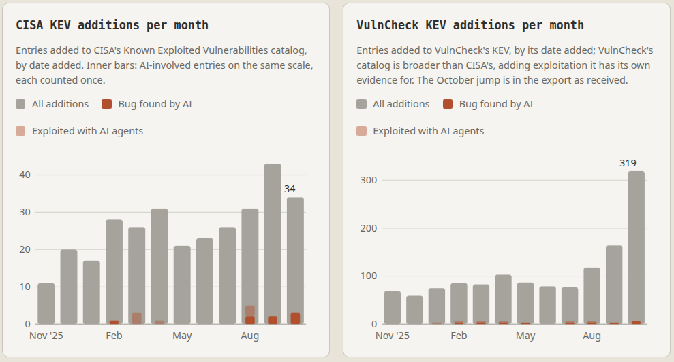
There has indeed been a general, though slightly bumpy, increase over the past 12 months, but it’s worth noting how much smaller these numbers are than our raw CVE counts.
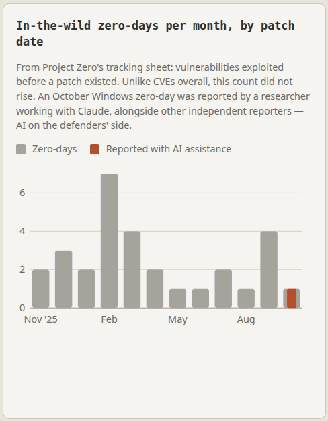
The vast majority of these bugs were exploited after being publicly disclosed. When we look at the rate of 0-days exploited in the wild, we see no steady upward trajectory. Here’s the relevant data from Google’s Project Zero and the US Cybersecurity and Infrastructure Security Agency (CISA) and VulnCheck KEV databases:
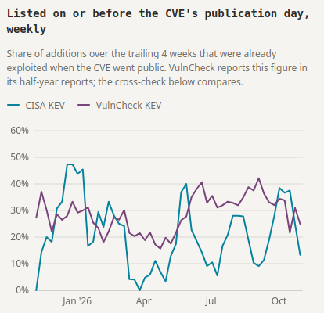
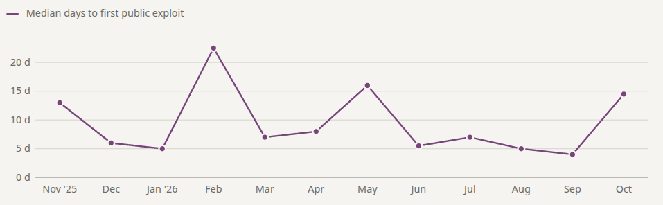
If we measure the lag between a vulnerability’s public disclosure and the time of its first recorded exploitation in the wild, as VulnCheck’s KEV does, we get a similarly uneven curve.
Attacks#
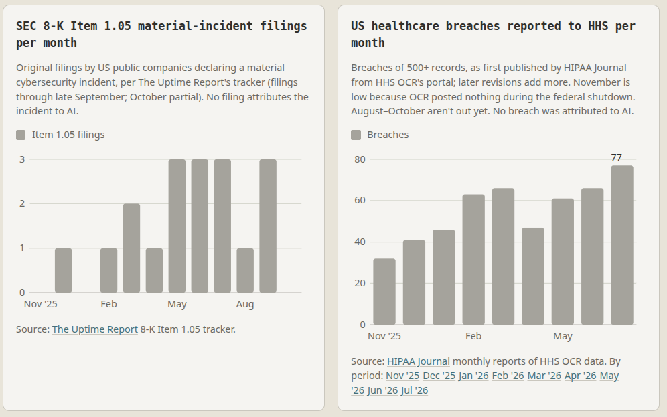
So it doesn’t, so far, seem as though the dramatic improvement in frontier AI’s cyber capabilities translates into a clear increase in the rate at which new vulnerabilities are getting exploited in actual attacks. But if we look at the rates of attacks themselves, we do see some signs that attackers are picking up the pace – though the story varies depending on what data source we look at.
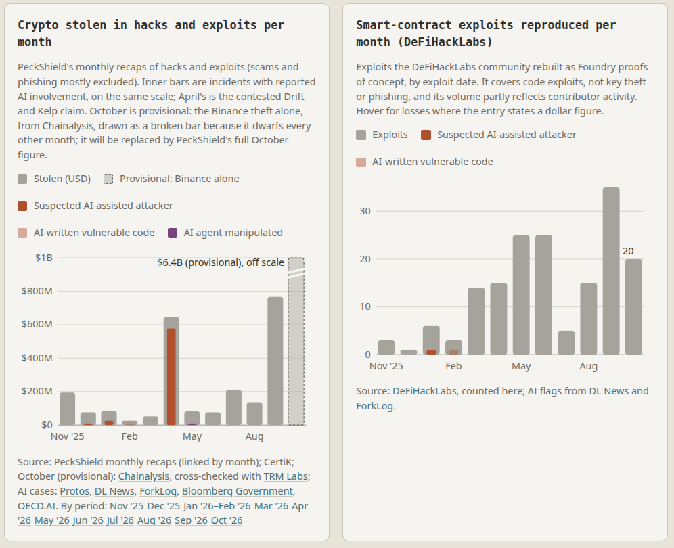
Blockchain security firm PeckShield’s monthly recap of crypto heists (Nov 2025, Dec 2025, Jan–Feb 2026, Mar 2026, Apr 2026, May 2026, Jun 2026, Jul 2026, Aug 2026, Sep 2026 – note that the October massive Binance heist isn’t yet reflected in their data) hints at an upward trend, but the titanic outliers make it hard to draw any clear conclusions. When the dust around the Binance heist settles, we might have more to say about this. There does seem to be a general climb in the rate at which smart contracts on the Ethereum blockchain are being exploited as well, according to data from DeFiHackLabs.
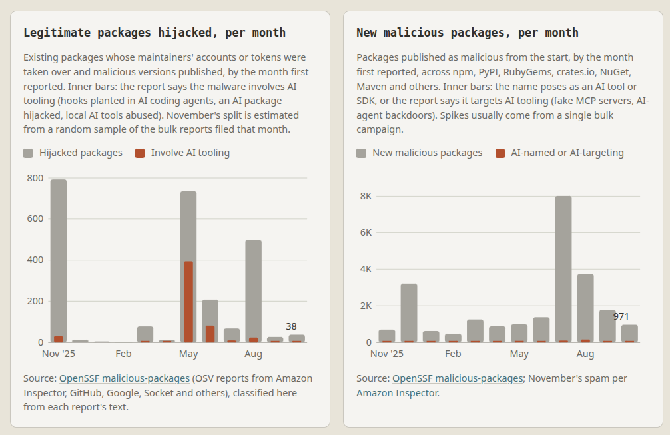
The AI tooling world seems to have become a particularly popular target for software supply chain attacks, and the story breaking at the time of writing, regarding the possible use of a compromised Claude Code extension for Cursor may tie this attack vector to one of the most financially damaging cyberattacks we’ve seen yet. (We cover this incident in the October 30 newsletter.)
Summary#
At present, it seems as though the contribution AI has made to vulnerability research and bug hunting is real, even if its exact contours are hard to pin down. When it comes to mounting actual cyberattacks, we see less of an impact. While many attackers no doubt avail themselves of the conveniences of coding assistants and agentic frameworks, this hasn’t yet made much of a difference to whether or not particular bugs get exploited. It does look like we’re seeing an acceleration in cyberattacks more broadly – typically the exploitation of bugs that have long been known and often already weaponized – but the reality of the situation again looks bumpier than the popular narrative. The most alarming AI security incident of the year, the OpenAI swarm’s attack on Hugging Face, was not launched by human attackers at all, and it doesn’t show up as a trend in any of these series.
We used Opus 5.5 to aggregate and plot the data for this report, and are maintaining a more detailed overview, to be updated monthly, as a Claude artifact, here.